The core beings in the shamanist religion are Father Heaven (Tenger Etseg) and Mother Earth (Gazar Eej). In history Chinggis Khan (Genghis Khan), the unifier of the Mongolian nation, based his power on a mandate from Tenger himself, and headed all his declarations with the words “by the will of Eternal Blue Heaven.” Father Heaven is worshiped for what he is, the timeless and infinite blue sky. He is not visualized as a person, although he is said to have at least two sons. Worship of Father Heaven and Mother Earth is almost universal in Siberia, and is found in North America as well.
The weather is seen as a direct manifestation of Tenger’s disposition. Tenger is the creator and sustainer of balance in the world, and the natural processes of weather and the circular motion of the seasons is sustained through him. Lightning is a sign of Tenger’s is pleasure or an indication of a site of high spiritual powers. When a lightning strike is a sign of displeasure, a shamanist ritual and yohor dance are made around the site where the lightning hit in order to send it back up to Heaven. Objects struck by lightning or meteorites and ancient artifacts are called Tengeriin Us (Heaven’s hair). They contain a spirit (utha) which is a concentrated package of Heaven’s power. Lightning struck objects (nerjer uthatai) and meteorites (buumal uthatai) can be placed in milk or liquor to energize the liquid with the spirit of the object. Shamans drink this preparation to incorporate the power of the utha spirit. Another form of Tengeriin us is the bezoar stone, which is used in rainmaking magic.
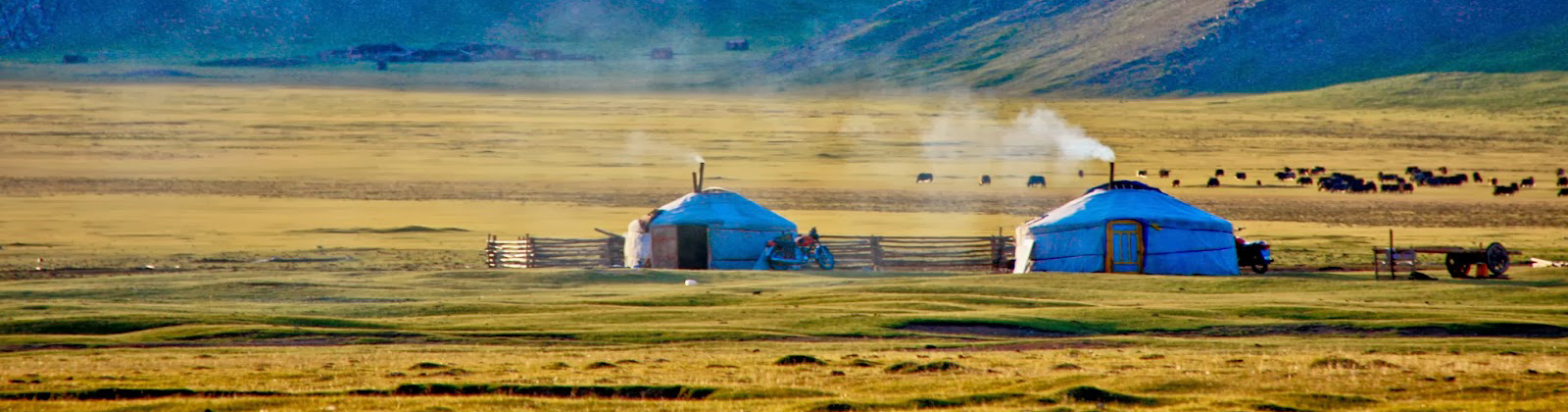
No shamanist ritual starts without the invocation of Father Heaven, Mother Earth, and the ancestors. Everyday activities acknowledge Tenger’s presence and is integral to living one’s life aligned with the balance of the universe. When a new bottle of liquor is opened, the top portion of the contents is poured into a container, taken outside, and offered to Father Heaven, Mother Earth, and the ancestors. This ritual, called tsatsah, is a very crucial one in the religion of Mongolia and Siberia. Housewives also offer milk and tea in the same way, walking around the ger flicking the liquid three times in each of the four directions. Tenger’s role in determining fate is acknowledged in everyday speech in phrases such as Tengeriin boshig (Heaven’s will). Women are required to keep their kitchens
and cooking utensils clean because to allow them to become dirty is an insult to Father Heaven. Prayers and offerings are made to Tenger on holidays and at times of sacrifices to the mountain spirits. There is also a special sacrifice to Father Heaven in times of mergency which is a private ritual. Rainmaking rituals directly address Tenger, and are held at oboo shrines dedicated to Tenger and the mountain spirits. Every human being has the right to appeal to Tenger directly for help; however when balance has been disrupted by calamity or the intrusion of a powerful spirit the shaman will use the power of his spirits to restore his patient’s connection with Tenger and state of balance with the universe.
The crown of the head has a small piece of Tenger residing in it; it is the point of connection between the individual standing in the center of his world and heaven above. This point receives energy from Tenger which flows down the center of the person’s soul sphere. This piece of Tenger in a person’s crown has a counterpart star in the heavens. The star shines brighter or dimmer according to the strength of the person’s windhorse. At death, the star goes out.
Mother Earth (Gazar Eej), like Father Heaven, is not visualized in human form, but for what she literally is, the earth from which we draw
nurturance and nourishment. She is also called Itugen, and the names for shamans, especially female shamans, are variations on the name (yadgan, utgan, udagan, etc.). This implies that shamans, have a very strong association with the veneration of Mother Earth. Her daughter, Umai, is the womb goddess and caretaker of the body souls roosting in the World Tree.
Umai is also known as Tenger Niannian, which comes from the Tungus word for “soil.” Trees are a manifestation of Mother Earth’s power, and worship of Mother Earth may be done at trees which suitably reflect her power and beauty. Mother Earth and her daughter Umai are appealed to for fertility. Another daughter of Mother Earth and Father Heaven, Golomto, the spirit of fire, is spoken of as begotten by flint and iron. Sitting beneath the smoke hole in the center of the earth, the sunlight falling upon it from above and being created by products of the earth, minerals and plant materials, fire is a re-enactment of the original union between heaven and earth. The light of the fire is a reminder of the light of Heaven, and its heat recalls the nurturing quality of Earth. Like trees, all human beings draw strength from the Mother Earth below as well as receiving the energy of Father Heaven through the crown of the head.
The sun and moon are the eyes of Tenger; they are also seen as two sisters, and their essences are fire and water. Their light represents the power of Tenger shining eternally upon the earth. The cycles of the sun and moon demonstrate the circularity of time and all other natural processes. For that reason, time is irrelevant from the standpoint of Siberian shamanism. Time circles around infinitely, so each point in time is in contact with every other. For that reason, time and distance have no meaning in shamanic rituals, and a shaman can be in direct contact with any time or location without moving. The center of the earth can be anywhere and in any time.
The amount of buyanhishig available from heaven seems to vary directly with the moon cycle; the most powerful days are at the times when the moon is new or full. The sun cycle, the solstices as well as the equinoxes, is coordinated with the moon cycle to set dates for festivals. For instance, the White Moon Festival which starts the year is held on the first new moon after the winter solstice, and the Red Round Festival is held on the full moon closest to the summer solstice.
Several other heavenly bodies are considered to have spiritual power. One is the planet Venus, Tsolmon, which can appear both in the morning or at night. It is often painted on shaman drums to invoke its power. Tsolmon is the sender of comets and meteors, which are called war arrows. The Big Dipper is called the Doloon Obgon (the Seven Old Men). Their position points out the location of the Pole Star (Altan Hadaas), which holds up the sky. The observation that the constellation rotates around the axis of the Pole Star through the year led to the creation of the has temdeg symbol, which superficially represents the swastika but actually represents the
position of the Big Dipper in the four seasons. Interestingly, this symbol is not only found in Siberia but in several Native American cultures as well, which may indicate a very ancient origin. The Pleiades are revered as another group of powerful spirits, and it was also the place where the sky spirits of the western direction met to decide to send the eagle to the earth as the first shaman. During the White Moon festival fourteen incense sticks are kept lit, seven for the Seven Old Men, and seven for thePleiades.